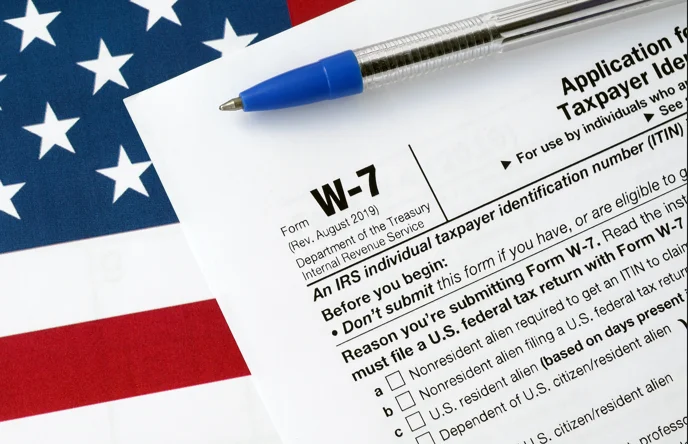
If you are a nonresident alien with income from U.S. sources, you may be entitled to reduce or even eliminate U.S. tax on that income. This is possible under a tax treaty between your home country and the United States. To take advantage of this benefit, however, you need an Individual Taxpayer Identification Number (ITIN), and that’s where Form W-7, box “a” comes in.
Who Is a Nonresident Alien?
In simple terms: a nonresident alien is someone who is not a U.S. citizen and does not meet the IRS “substantial presence test” for being treated as a U.S. resident.
You are considered a nonresident alien if you live outside the U.S. but have U.S. income (from investments, royalties, services, or scholarships).
Examples include:
- A freelancer in India working for a U.S. client.
- A Canadian student receiving a U.S. scholarship.
- A German investor earning dividends from U.S. companies.
In short, if you don’t live in the U.S. as a resident but still earn from U.S. sources, you’re likely a nonresident alien.
What Does “Box A” on Form W-7 Mean?
When you check box “a” (Nonresident alien required to get an ITIN to claim tax treaty benefit), you are telling the IRS that:
- You are not a U.S. citizen or resident alien.
- You receive income from a U.S. source (like dividends, royalties, scholarships, or business income).
- You want to apply a tax treaty benefit to lower the amount of tax withheld.
Because tax treaties are country-specific, you must also complete box h to provide details such as:
- The treaty country (your country of residence).
- The treaty article number that applies to your type of income.
When Should You Choose Box A?
You should select box a if:
- You are a nonresident alien investor earning dividends, interest, or capital gains from U.S. companies.
- You are a foreign freelancer or consultant providing services to U.S. clients, and a treaty reduces withholding.
- You are a student or researcher receiving a scholarship or grant covered under your country’s tax treaty with the U.S. (note: this may also overlap with box f, but box a applies when the primary reason is claiming treaty benefits).
- You receive royalties or licensing income from U.S. publishers or businesses.
Example: A resident of the U.K. receives book royalties from a U.S. publisher. Under the U.S.-U.K. tax treaty, royalties may be taxed at 0% or a reduced rate. To apply this benefit, the individual needs an ITIN.
Documents You’ll Need
To support your W-7 application under point a, prepare:
- Proof of identity and foreign status: usually a valid passport (preferred by the IRS).
- Tax treaty reference: the specific article and country written in box h.
- Supporting income document: such as a letter from the withholding agent, a scholarship grant letter, or a Form 1042-S showing expected income.
How to Complete Box H Alongside Point A
After checking box a, you must:
- Enter your treaty country (for example, “Canada”).
- Enter the specific article number in the treaty that covers your income type (e.g., “Article 12 – Royalties”).
- Provide any additional information requested in the instructions (such as income type and U.S. withholding agent details).
Common Mistakes to Avoid
- Not including a federal tax return: for box a, you typically must attach a U.S. tax return unless you qualify for an exception (e.g., you already have a withholding agent requiring your ITIN to apply treaty benefits at source).
- Forgetting box h: leaving box h blank can cause delays or rejection.
- Incorrect treaty article: make sure you reference the correct treaty and article. Each country’s treaty is unique.
- Submitting copies instead of originals: the IRS only accepts originals or certified copies of documents (unless applying through a Certified Acceptance Agent).
Why an ITIN Matters for Treaty Benefits
Without an ITIN, U.S. payers are required to withhold tax at the default 30% rate on your U.S. income. With a valid ITIN and the right treaty claim:
- You may reduce withholding to 0% or a lower treaty rate.
- You can claim a refund for any overpaid tax when filing your U.S. return.
- You ensure compliance with both IRS and your home country’s tax authorities.
Final Thoughts
Form W-7, box a, is the key for nonresident aliens who want to claim tax treaty benefits. By properly filling in both box a and box h, attaching the right documents, and referencing the correct treaty article, you can unlock significant tax savings and stay IRS-compliant.
If you’re unsure which treaty article applies, it’s wise to seek help from a tax professional or Certified Acceptance Agent (CAA) like EasyFormX, who can guide you through the process and avoid costly mistakes.
Ready to apply? Get started with your ITIN application or book a free consultation to confirm which treaty benefits apply to you.


